this week, i am doing something new. i have a guest blogger! woo hooo!! christina newcomb is a good friend of mine, and she had something to say. so i am loaning her my place to say things. she and i agree on much and agree to disagree on some. i tried not to edit beyond basic formatting, so here are her thoughts as she wrote them!! i will give you the insight that the spark for much of this thinking began when she with the below picture posted to facebook (which i also posted), and people she knew responded. i love you guys.
I often Christians state that they “hate the sin, but love the sinner” and I wonder about how this statement is acted out in real life. How can you show someone that you hate their sin, but love them. If we believe “…righteousness is given through faith in Jesus Christ to all who believe….for all have sinned and fall short of the glory of God”(Romans 3:22a, 23), then how can we say we hate sin and love the sinner, when someone, who has not yet put their faith in Christ, is still defined by, and a slave to that very sin?
The bible instructions when it comes to pointing out other peoples sin only applies to other Christians. Hebrews 3:13 tells us that “…we must warn each other every day, while it is still “today,” so that none of you will be deceived by sin and hardened against God” (Hebrews 3:13). But when it comes to non-believers, Paul says “What business is it of mine to judge those outside the church? Are you not to judge those inside? God will judge those outside.” (1 Cor 5:12)
Romans 1 lists so many sins, that it is almost dizzying how sinful we are as a people, and as we read it, we often see the sins of unbelievers on there, and we start to feel like judging them is justified. However, if we continue reading and just slide right into the 2nd chapter (just as it was meant to be read), we are immediately brought back to the reality of our own sin: “You may think you can condemn such people, but you are just as bad, and you have no excuse! When you say they are wicked and should be punished, you are condemning yourself, for you who judge others do these very same things. And we know that God, in his justice, will punish anyone who does such things. Since you judge others for doing these things, why do you think you can avoid God’s judgment when you do the same things? Don’t you see how wonderfully kind, tolerant, and patient God is with you? Does this mean nothing to you? Can’t you see that his kindness is intended to turn you from your sin?”
One translation says “Don’t you see that it is God’s loving Kindness that leads you to repentance?” Imagine what God’s loving kindness is for you. What it has looked like in your life as He has turned you from your sin, time and time again. Daily. Moment by moment. Lovingly.
To become a Christian, a person has to first come to the realization that they are a sinner, which is in fact the hardest part for all of my non-Christian friends. How many times, when we share our faith do we hear the words “but I’m a good person.” It’s so difficult to accept that you are a sinner, because “All who do evil hate the light and refuse to go near it for fear their sins will be exposed” John 3:20 That is why this loving kindness of God is so important.
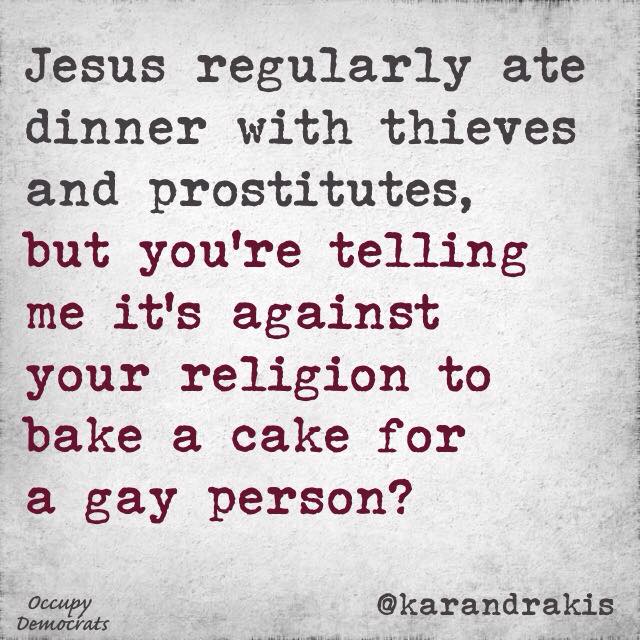
Do you think non-believers, specifically homosexuals, encounter God’s loving kindness when they encounter a Christian?
Gays not only have to realize they are sinners like they rest of us, but they also have to overcome the “Christian” people standing in front of them blocking their way.
When the Pharisees saw Jesus eating at Matthew, the tax collector’s house, they asked his disciples, “Why does your teacher eat with such scum?” When Jesus heard this, he said, “Healthy people don’t need a doctor—sick people do.” Then he added, “Now go and learn the meaning of this Scripture: ‘I want you to show mercy, not offer sacrifices.’ For I have come to call not those who think they are righteous, but those who know they are sinners.” (Matthew 9:11)
I want to remind all of us that we were all sick when we enter the hospital of faith. Matthew was sick. But then he encountered Christ on the road, and was given an infusion of life giving blood. Not outside on the front steps, to be made well before entering, but inside, in a bed, with a merciful doctor. “God showed His great love for him by sending Christ to die for him while he was still a sinner” (Rom 5:8)
And “you must love the Lord your God with all your heart, all your soul, all your strength, and all your mind.’ And, ‘Love your neighbor as yourself.’” (Luke10:27 Why is it that many Christians don’t see gays as their “neighbor?”
The bakers who refused to make a gay couple a cake, make cakes every day for people who have “lives…full of every kind of wickedness, sin, greed, hate, envy, murder, quarreling, deception, malicious behavior, and people who “are” gossipers….backstabbers, haters of God, insolent, proud, and boastful…and people who disobey their parents.” (Romans1:29) But they have decided that it is “against their religion” to serve someone who is marrying someone of the same sex.
When Christians say something is “against our religion,” what are we saying? What is “religion”? Jesus said ‘These people honor me with their lips, but their hearts are far from me. They worship me in vain; their teachings are merely human rules. You have let go of the commands of God and are holding on to human traditions.” (Mark 7:6b-8) The definition of religion is “an organized system of beliefs, ceremonies, and rules used to worship a god or a group of gods.” Religion by its very definition is holding onto mere human rules, and not fervently looking to what Christ said and did.
Jesus says “I entered this world to render judgment—to give sight to the blind and to show those who think they see that they are blind.” Some Pharisees who were standing nearby heard him and asked, “Are you saying we’re blind?” and Jesus replied “If you were blind, you wouldn’t be guilty, but you remain guilty because you claim you can see.” (John9:39)
I don’t want to be blind. I don’t want to blindly be told to treat people a certain way because it is my religion. What I know, is that “God sent his Son into the world not to judge the world, but to save the world through him.” (John3:17) and that I am God’s handiwork, created in Christ Jesus to do good works, which God prepared in advance for me to do.” (Eph 2:10)
God makes no distinction between sin and sinner. We are all detestable in His sight because on our best day, “all of our righteous acts are as filthy rags before the LORD.” (Isaiah 64:6) But our hope lies in “..having now been justified by Christ’s blood, we shall be saved from the wrath of God through Him.” (Romans 5:9)
So, what then is Jesus’ stance towards sin and sinners? He covers it. He covers every last bit of it, for those who believe. He bore it and was broken by it. His blood is the only thing that saves sinful people from God’s wrath.
Can we please stop using “our religion” to stand between people whose only hope is Jesus? People. who are just like we once were….lost.
If you can’t, then do like your mom says, “If you have nothing nice to say, say nothing at all.” And let “God’s loving kindness turn them to repentance” just like He did for you.
 a strange mix of flavors
Your theology is spot on. But you’re wrong when you say that refusing to bake a cake is the same as “refusing to serve” someone. No one is refusing to sell a water bottle, a car, or a house to a gay person. Baking a cake, planning the wedding, and taking photographs are different. Then you are entering into the ceremony, celebrating something that God tells us we ought not to celebrate – sin, which you correctly say incurs God’s judgment.
So there is a fine line here. We are to serve with love and joy, and share our faith with gentleness and respect. If a Christian believes they can do that by baking a cake and that doesn’t compromise their principles, I think there is liberty for them to do so.
If another cannot do it in good conscience, then I wouldn’t tell them to keep their mouths shut, but to answer lovingly and gently, sharing their faith as well.
Christians absolutely should have liberty not to participate in ceremonies that contradict their beliefs. I would not celebrate a sacrifice to Satan, a Buddhist ordination (if there is such a thing), a Catholic mass (which re-sacrifices the body of Christ, a profanation of His actual sacrifice), or a gay wedding. To do so is to approve of, and enter into, what is wrong.
Melanie,
Thank you for taking the time to read my guest blog. And thank you for taking the time to respond so thoughtfully.
Excellent Blog post Christina and I totally agree with your theology; not so much with some of Melanie’s response (isn’t it wonderful that God made each of unique?!)
I can respect the right of business owners to have different opinions and stand by those opinions. So if the issue was that the bakery owners were committed to serve only those couples participating in a marriage as their church defines marriage then — Bravo, stand by your convictions. But then do you hand out a questionnaire to all couples coming in the buy a wedding cake? There are plenty of marriages that would not fit in that definition but how would you know? So unless you’re carrying those convictions across the board then to refuse service to a gay couple borders on bigotry, judgment, and unlawful discrimination.
Acceptance and Approval are mutually exclusive. Jesus called us to love one another.